---
title: Can a Nor'easter Turn Into a Hurricane? | WeatherBug | WeatherBug
description: When you think of a nor'easter, you probably picture strong winds, heavy snow, and coastal flooding. But did you know that under the right conditions, a nor'easter can actually transform into a tropical storm or even a hurricane?
canonical: https://www.weatherbug.com/news/Can%20a%20Noreaster%20Turn%20Into%20a%20Hurricane
og:title: Can a Nor'easter Turn Into a Hurricane? | WeatherBug | WeatherBug
og:description: When you think of a nor'easter, you probably picture strong winds, heavy snow, and coastal flooding. But did you know that under the right conditions, a nor'easter can actually transform into a tropical storm or even a hurricane?
og:url: https://www.weatherbug.com/news/Can%20a%20Noreaster%20Turn%20Into%20a%20Hurricane
og:site_name: WeatherBug
og:locale: en_US
og:image: https://cms-assets-con.cdn.weatherbug.net/assets/contentitems/9d/9d97dea9-4384-4cb0-8ae9-d8e98e883163/52e0ce98-d40a-4283-82d1-d0fe816ebf4b/d6060879-0422-45a4-bfb4-163aa399b18f.png
og:image:width: 800
og:image:height: 600
og:image:alt: Can a Nor'easter Turn Into a Hurricane?
og:type: article
article:published_time: 2026-10-23T15:24:13Z
article:modified_time: 2026-10-23T15:24:13Z
article:author: By WeatherBug Meteorologist, Brittney Gomez
article:tag: noreaster
article:tag: hurricane
article:tag: storm
article:tag: nor'easter
article:tag: northeast
article:tag: tropics
twitter:card: summary_large_image
twitter:title: Can a Nor'easter Turn Into a Hurricane? | WeatherBug
twitter:description: When you think of a nor'easter, you probably picture strong winds, heavy snow, and coastal flooding. But did you know that under the right conditions, a nor'easter can actually transform into a tropical storm or even a hurricane?
twitter:image: https://cms-assets-con.cdn.weatherbug.net/assets/contentitems/9d/9d97dea9-4384-4cb0-8ae9-d8e98e883163/52e0ce98-d40a-4283-82d1-d0fe816ebf4b/d6060879-0422-45a4-bfb4-163aa399b18f.png
---
[](/)
[Back to forecast](/)
# Can a Nor'easter Turn Into a Hurricane?
October 23, 2026 at 11:24 AM EDT
By WeatherBug Meteorologist, Brittney Gomez
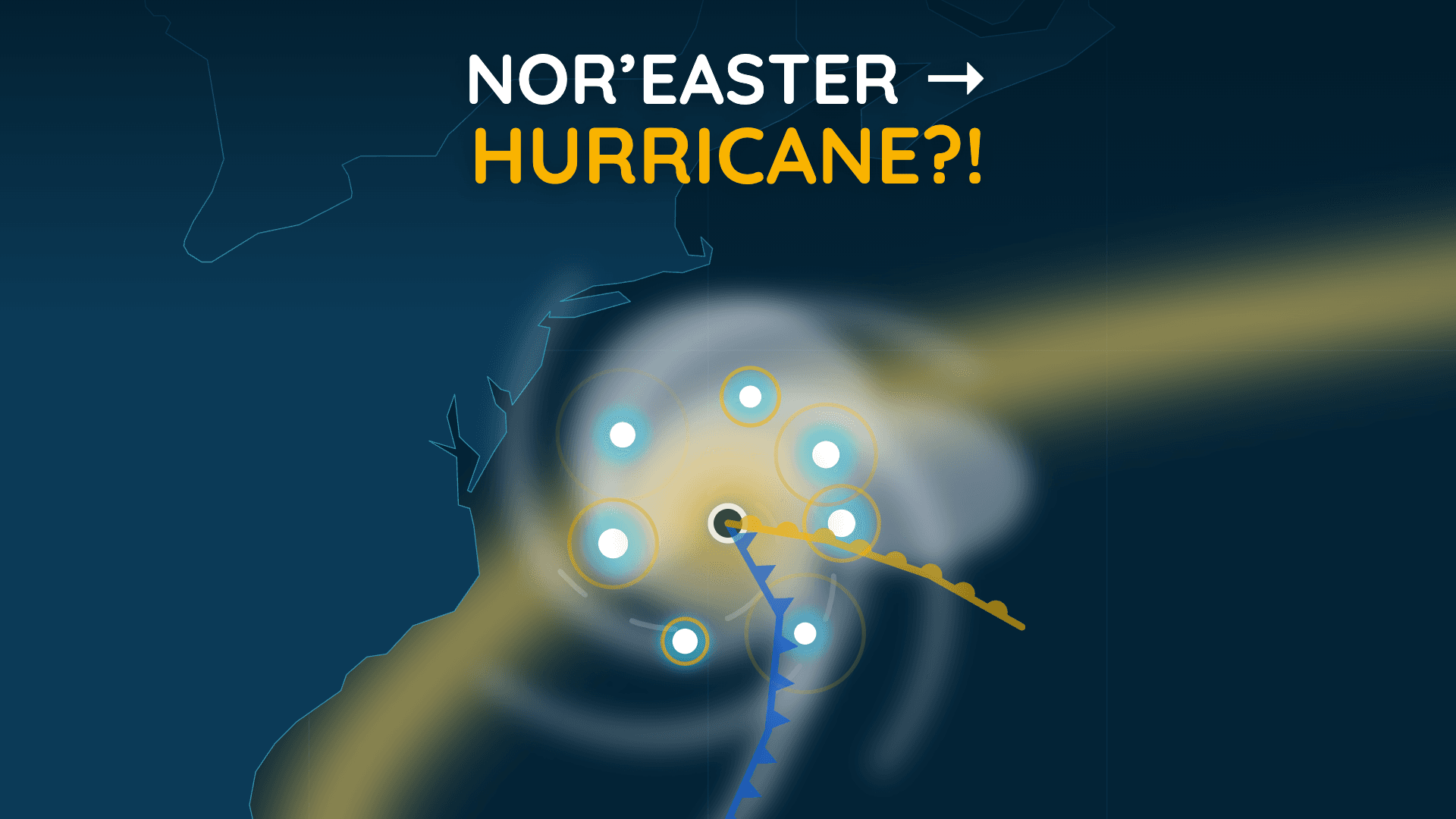
When you think of a nor'easter, you probably picture strong winds, heavy snow, and coastal flooding. But did you know that under the right conditions, a nor'easter can actually transform into a tropical storm or even a hurricane?
It doesn't happen often, but the science behind it is pretty interesting!
## **What Makes a Nor'easter Different From a Hurricane?**
Nor'easters are typically extratropical cyclones, meaning they get much of their energy from temperature differences between warm and cold air masses.
Think of cold air moving south from Canada and meeting warmer, moisture-filled air over the Atlantic. That temperature contrast can help fuel a powerful storm, bringing strong winds, heavy precipitation, and coastal flooding.
Tropical storms and hurricanes work differently. Instead of relying on temperature contrasts, they draw energy from warm ocean waters and the heat released as water vapor condenses into clouds and thunderstorms.
Tropical cyclones also typically have a warm core, organized thunderstorms near their center, and no attached warm or cold fronts.
## **How Can a Nor'easter Become Tropical?**
Sometimes, an extratropical storm can move into an environment favorable for tropical development.
As the storm loses its frontal characteristics and thunderstorms organize closer to its center, its energy source and internal structure can begin to change.
The system may first develop subtropical characteristics, combining features of both tropical and non-tropical storms. We call this subtropical.
If it develops a fully tropical structure, it can be classified as a tropical cyclone. With maximum sustained winds of at least 39 mph, it's a tropical storm. At 74 mph, it becomes a hurricane.
## **Can the Transition Happen in Reverse?**
Yes! Tropical cyclones can also transition into extratropical storms as they move into environments with stronger temperature contrasts. This process is known as extratropical transition.
While most nor'easters never become tropical systems, these transitions show just how much a storm can change throughout its lifetime.
We use technologies, such as cookies, to analyze your use (i.e., pages visited), to customize content, for our internal analytics purposes and for security and other purposes. By continuing to use this website, you agree to this usage. Please review our [privacy policy](/legal/privacy) for more details as well as for information on how to contact us to object to these activities. [Ad Choices](/legal/privacy#digitaladvertisingandyourchoices)
```json
{"@context":"https://schema.org","@type":"NewsArticle","mainEntityOfPage":{"@type":"WebPage","@id":"https://www.weatherbug.com/news/Can a Noreaster Turn Into a Hurricane"},"headline":"Can a Nor'easter Turn Into a Hurricane?","description":"When you think of a nor'easter, you probably picture strong winds, heavy snow, and coastal flooding. But did you know that under the right conditions, a nor'easter can actually transform into a tropical storm or even a hurricane?","image":["https://cms-assets-con.cdn.weatherbug.net/assets/contentitems/9d/9d97dea9-4384-4cb0-8ae9-d8e98e883163/52e0ce98-d40a-4283-82d1-d0fe816ebf4b/d6060879-0422-45a4-bfb4-163aa399b18f.png"],"datePublished":"2026-10-23T15:24:13Z","dateModified":"2026-10-23T15:24:13Z","dateCreated":"2026-10-23T15:24:13Z","articleSection":"Weather News","keywords":"noreaster,hurricane,storm,nor'easter,northeast,tropics","articleBody":"When you think of a nor'easter, you probably picture strong winds, heavy snow, and coastal flooding. But did you know that under the right conditions, a nor'easter can actually transform into a tropical storm or even a hurricane?
It doesn't happen often, but the science behind it is pretty interesting!
What Makes a Nor'easter Different From a Hurricane?
Nor'easters are typically extratropical cyclones, meaning they get much of their energy from temperature differences between warm and cold air masses.
Think of cold air moving south from Canada and meeting warmer, moisture-filled air over the Atlantic. That temperature contrast can help fuel a powerful storm, bringing strong winds, heavy precipitation, and coastal flooding.
Tropical storms and hurricanes work differently. Instead of relying on temperature contrasts, they draw energy from warm ocean waters and the heat released as water vapor condenses into clouds and thunderstorms.
Tropical cyclones also typically have a warm core, organized thunderstorms near their center, and no attached warm or cold fronts.
How Can a Nor'easter Become Tropical?
Sometimes, an extratropical storm can move into an environment favorable for tropical development.
As the storm loses its frontal characteristics and thunderstorms organize closer to its center, its energy source and internal structure can begin to change.
The system may first develop subtropical characteristics, combining features of both tropical and non-tropical storms. We call this subtropical.
If it develops a fully tropical structure, it can be classified as a tropical cyclone. With maximum sustained winds of at least 39 mph, it's a tropical storm. At 74 mph, it becomes a hurricane.
Can the Transition Happen in Reverse?
Yes! Tropical cyclones can also transition into extratropical storms as they move into environments with stronger temperature contrasts. This process is known as extratropical transition.
While most nor'easters never become tropical systems, these transitions show just how much a storm can change throughout its lifetime.
","author":{"@type":"Person","name":"By WeatherBug Meteorologist, Brittney Gomez","url":"https://www.weatherbug.com"},"publisher":{"@type":"Organization","name":"WeatherBug","logo":{"@type":"ImageObject","url":"https://www.weatherbug.com/images/sharing/f1ff28ba-6f06-4745-a782-011a20397e16.png"}}}
{"@context":"https://schema.org","@type":"WebSite","mainEntityOfPage":{"@type":"WebPage","@id":"https://www.weatherbug.com/news/Can%20a%20Noreaster%20Turn%20Into%20a%20Hurricane","relatedLink":"https://www.weatherbug.com/news/Can%20a%20Noreaster%20Turn%20Into%20a%20Hurricane"},"name":"WeatherBug","url":"https://www.weatherbug.com/news/Can%20a%20Noreaster%20Turn%20Into%20a%20Hurricane","headline":"Can a Nor'easter Turn Into a Hurricane?","description":"When you think of a nor'easter, you probably picture strong winds, heavy snow, and coastal flooding. But did you know that under the right conditions, a nor'easter can actually transform into a tropical storm or even a hurricane?","dateModified":"2026-10-23T15:24:13Z","publisher":{"@type":"Organization","name":"WeatherBug","url":"https://www.weatherbug.com","sameAs":["https://www.facebook.com/WeatherBug","https://instagram.com/WeatherBug","https://www.linkedin.com/company/weatherbug","https://www.pinterest.com/weatherbug","https://twitter.com/WeatherBug","https://www.youtube.com/user/WeatherBugVideo"],"logo":{"@type":"ImageObject","url":"https://www.weatherbug.com/images/logos/weatherbug_logo_620x447.png"}},"author":{"@type":"Organization","name":"WeatherBug","url":"https://www.weatherbug.com","sameAs":["https://www.facebook.com/WeatherBug","https://instagram.com/WeatherBug","https://www.linkedin.com/company/weatherbug","https://www.pinterest.com/weatherbug","https://twitter.com/WeatherBug","https://www.youtube.com/user/WeatherBugVideo"],"logo":{"@type":"ImageObject","url":"https://www.weatherbug.com/images/logos/weatherbug_logo_620x447.png"}}}
{"@context":"https://schema.org","@type":"Organization","name":"WeatherBug","logo":"https://www.weatherbug.com/images/logos/weatherbug_logo_620x447.png","url":"https://www.weatherbug.com","sameAs":["https://www.facebook.com/WeatherBug","https://instagram.com/WeatherBug","https://www.linkedin.com/company/weatherbug","https://www.pinterest.com/weatherbug","https://twitter.com/WeatherBug","https://www.youtube.com/user/WeatherBugVideo"]}
```